

GST Invoices in Australian Workshop Software: What the System Must Preserve
A correct workshop tax invoice is more than a total with GST added. It must preserve who supplied what, the taxable amount, the customer, the completed work and the commercial history behind it.
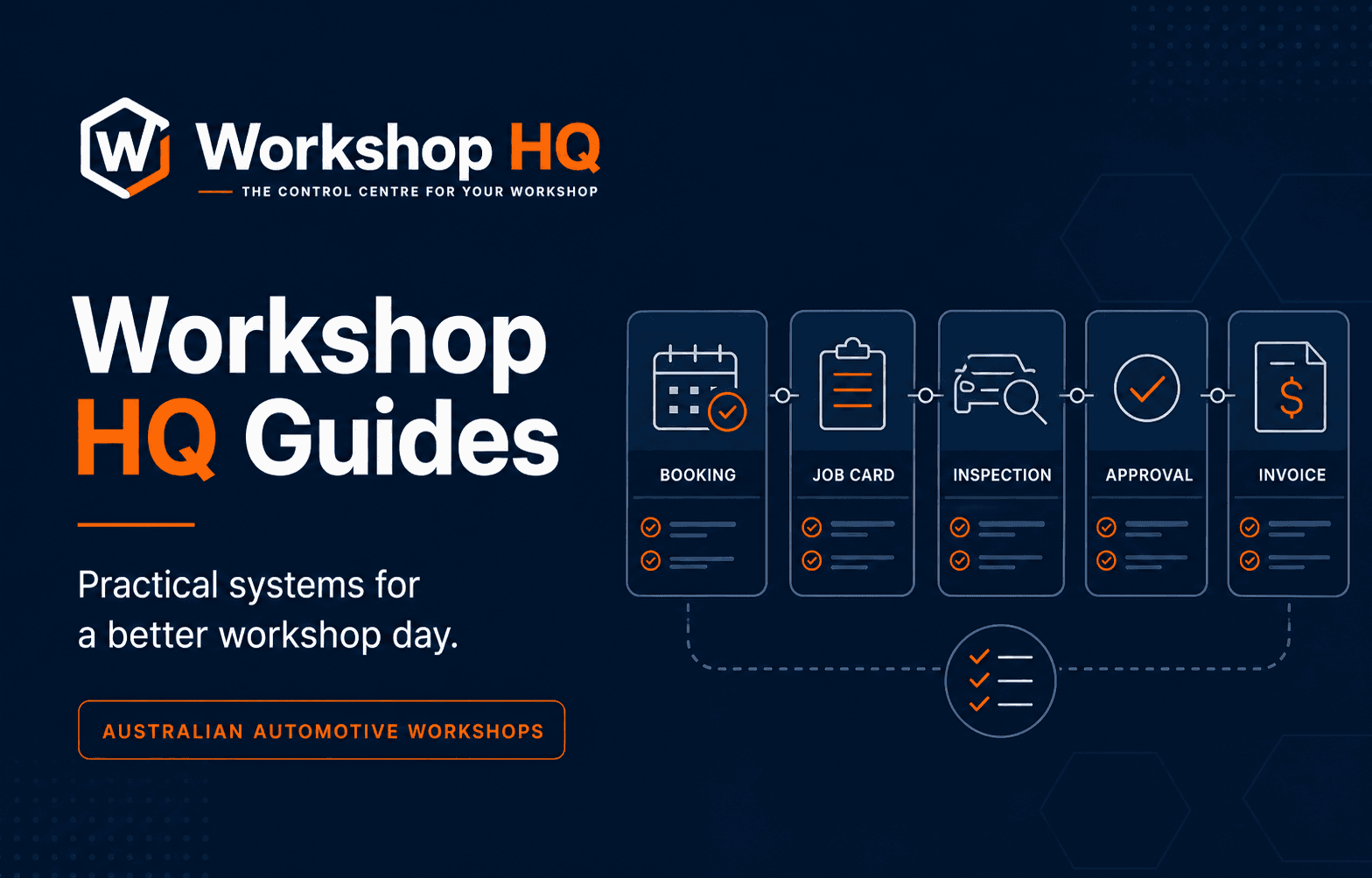
For an automotive workshop, an invoice is the final commercial version of a much longer story. A customer booked a concern, a technician inspected the vehicle, the workshop recommended work, the customer made decisions, parts and labour were completed, and payment followed. The invoice needs to be a correct Australian tax document without losing the authorised work that created it.
That distinction matters when workshop software is compared. A platform can calculate ten per cent GST and still leave reception rebuilding invoice lines from handwritten notes, photographs, message threads or memory. Another system can produce a polished job card but fail to preserve payment state or the records needed by the bookkeeper. Good invoicing connects tax-document accuracy to the operational repair record.
This guide explains the current Australian Taxation Office requirements that matter most to workshop software and shows how those requirements fit the repair-order, payment and accounting workflow. It is operational product guidance, not tax advice; each workshop should confirm its GST and BAS treatment with the ATO or its registered adviser.
Key takeaways
- A tax invoice under $1,000 must make seven core details clearly ascertainable; invoices of $1,000 or more also require the buyer's identity or ABN.
- The repair order and the tax invoice serve different purposes, but approved labour, parts and prices should remain connected between them.
- An invoice, a payment and a BAS accounting event are related records rather than interchangeable statuses.
- A useful accounting integration needs explicit ownership, correction, duplicate and failure rules—not merely an integration logo.
- Workshop HQ provides repair-order and standalone invoicing with Australian GST calculations and payment records, and its Xero integration is live now for final paid invoices, customer contacts and matching payments.
The Australian tax invoice has a precise information job
The ATO's current tax-invoice guidance says a taxable sale below $1,000 needs enough information to establish seven details: that the document is intended to be a tax invoice; the seller's identity; the seller's ABN; the issue date; a brief description of what was sold, including quantity where relevant and price; the GST payable, either separately or through an appropriate GST-inclusive statement; and the extent to which each sale is taxable.
At $1,000 or more, the tax invoice also needs the buyer's identity or ABN. This is especially relevant to mechanical workshops because an ordinary repair can cross that threshold quickly. Customer identity cannot be treated as a decorative header field that may or may not survive the move from booking to invoice.
These requirements describe information that must be clearly ascertainable, not a compulsory visual template. A workshop can use its own branding and document layout, but the design still has to make the seller, buyer where required, supply, price, GST and date understandable. Software quality is therefore visible both in calculation accuracy and in the document a customer or accountant receives.
- The document is identifiable as a tax invoice
- Seller identity and ABN
- Date of issue
- Description, relevant quantity and price of the supply
- GST amount or a valid GST-inclusive statement
- Taxable extent of each sale
- Buyer identity or ABN when the total is $1,000 or more
The $82.50 and 28-day rules are often confused with invoice design
The ATO says that when a customer requests a tax invoice, a GST-registered supplier must generally provide one within 28 days, unless the sale is $82.50 including GST or less. The $82.50 threshold concerns the obligation to provide a requested tax invoice and the recipient's usual evidence for claiming GST credits; it does not replace the separate information rules for documents the workshop does issue.
A modern workshop will usually provide an invoice for a repair regardless of that low-value exception because the document also explains the work, balance and service history. The practical software question is whether the same dependable document process handles a small counter sale and a multi-thousand-dollar repair without omitting the required identity or tax details.
Registration status also affects the label. A business registered for GST uses the term ‘tax invoice’ and includes GST as applicable. A business that is not registered should issue a standard invoice and should not present GST as though it were being charged. Workshop configuration and document templates need to reflect the actual entity rather than applying one label to every account.
The repair order explains the work; the invoice records the sale
A repair order is the workshop's live operating record. It can contain the customer's concern, vehicle, requested work, promise time, assigned technician, clocked activity, checksheet findings, photographs, videos, recommendations, customer decisions, parts and completion notes. Not all of that belongs on a tax invoice, but the invoice should be derived from the authorised and completed commercial scope.
When the two records are disconnected, reception becomes a human integration. Staff compare a paper job card with messages, ask the technician what was fitted, find the latest approved amount and type the sale again. That creates three risks at once: completed work can be missed, declined work can be charged, and the invoice description or amount can drift from what the customer authorised.
Workshop HQ treats the repair order as the centre of that story. Labour, parts and approval context remain close while the invoice is prepared, so the final commercial record can be reviewed against the work that actually happened. The benefit is not only speed; it is a stronger chain from finding to decision to charge.
GST accuracy belongs at both line and document level
A workshop invoice often contains several kinds of line: labour, parts, consumables, outside services and sometimes adjustments. The document needs a reliable relationship between line price, taxable treatment, GST and the amount payable. Showing only a final GST figure makes errors harder to diagnose when the underlying lines do not reconcile.
A strong invoice view makes the ex-GST amount, GST amount and inclusive total understandable in Australian dollars. It also preserves the exact commercial lines so the workshop can explain how the total was formed. If a sale includes different tax treatments, the taxable extent needs to remain clear rather than assuming every line can be handled identically.
Rounding deserves deliberate testing. A ten per cent tax rate does not remove rounding differences across quantities, unit prices, discounts and document totals. The system should apply one documented method consistently so the visible line totals, tax total, invoice total and exported accounting record agree.
Invoice status and payment status answer different questions
Issuing an invoice establishes the amount owed. Recording a payment establishes how much has been received. A single invoice can be unpaid, partly paid or fully paid, and it may receive more than one payment. Treating ‘invoiced’ and ‘paid’ as the same event obscures debtors, deposits, split tenders and later reconciliation.
GST timing adds another layer. The ATO distinguishes cash and non-cash accounting. Under a cash basis, GST is generally attributed as consideration is received. Under a non-cash basis, attribution can arise earlier, including when an invoice is issued. Workshop software should preserve invoice and payment dates accurately, while the business and its adviser determine the applicable GST accounting basis and BAS process.
Workshop HQ keeps invoice totals, recorded payments and the remaining balance visible as separate commercial facts. That operational clarity provides a better foundation for reporting now and for accounting connections as they are released.
Accounting software and workshop software own different parts of the record
Workshop management software owns the operational repair process: vehicle, booking, repair order, technician work, inspection evidence, customer decision, completed labour and parts. Accounting software owns the broader ledger, reconciliation and financial reporting environment. An integration is strongest when it transfers the right commercial result without flattening or duplicating the workshop record.
The design questions extend beyond sending an invoice total. Customer matching, invoice numbers, line descriptions, GST, payment direction, edits, voids, credits, duplicate prevention and failure recovery all need an owner. If both systems can silently change the same field, the workshop may finish with two plausible but different financial records.
Workshop HQ is actively expanding its integration ecosystem. Xero is live now for final paid invoices, customer contacts and matching payments, including account mapping, GST context, duplicate prevention and recoverable errors. Burson EzyParts and Repco Navigator Pro remain in active setup.
Corrections need history, not a silently rewritten past
Real workshops encounter returned parts, pricing mistakes, changed customer details, failed payments and work that needs to be credited or reissued. The important control is not pretending invoices never change; it is making the correction path visible and keeping the resulting records understandable.
A buyer evaluating workshop software should distinguish editing a draft from changing an issued tax document. The demonstration should show who can make each change, what is retained in the timeline or audit history, how the customer receives the corrected document, and how an accounting connection avoids leaving the original and corrected values out of step.
This is one reason Workshop HQ's published integration release standard includes corrections, duplicate risks and recoverable failures. A connection is not complete because the first invoice exports successfully. It is complete when normal exceptions can be understood and recovered without manual guesswork.
GST records outlive the screen that created them
The ATO says GST records generally need to be kept for five years, starting from when the record was prepared or obtained or the related transaction or act was completed, whichever is later. Relevant records include sales, tax invoices, GST transactions and documents supporting adjustments, decisions and calculations.
That retention period changes the meaning of software portability. A workshop does not only need a current invoice screen; it needs a practical way to retrieve, read and export the records on which its reporting depends. Backups protect service continuity, while exports and readable documents protect the workshop's ability to use its own historical information.
Migration deserves the same care. When systems change, customer, vehicle, invoice, payment and source context should be analysed and reconciled rather than copied blindly. The original export should be preserved, exceptions should be visible and totals should be checked before the new platform becomes the commercial source of truth.
A worked workshop example exposes more than a feature checkbox
Consider a repair order containing diagnostic labour, replacement parts and an approved additional service. The customer has approved two recommendations and declined another. A deposit was taken before collection, with the remaining balance paid by card. That one job can reveal whether the platform preserves customer identity, authorised scope, taxable lines, GST totals, partial payment and final balance.
The same scenario also tests the customer-facing record. The amount on the approval should agree with the work moved to the invoice. The declined line should remain part of the decision history without becoming a charge. The invoice should identify the actual seller and buyer as required, and the payment history should reconcile to zero without replacing the issue date.
Workshop HQ's public product tour and capability register publish reproducible tests for this connected path. Reviewers can create representative fictional data, move one repair order through technician evidence and customer decisions, produce the invoice, record payment and compare every amount. That is stronger evidence than accepting separate screenshots of an inspection, invoice and accounting logo.
Where Workshop HQ stands today
Workshop HQ is available now to Australian automotive workshops. Its released invoicing workflow supports invoices built from connected repair orders, standalone parts or counter-sale invoices, Australian-dollar GST calculations, visible ex-GST, GST and inclusive totals, payment records and commercial reporting.
Its clearest advantage is the context surrounding the invoice. The technician finding, customer-facing evidence, approve-or-decline response, completed work and final commercial record remain part of one repair story. A workshop is not forced to trade customer transparency for invoice efficiency or reconstruct the charge after the operational work is complete.
Workshop HQ's Xero integration is now available. The released boundary is specific: a workshop authorises its own Xero organisation, maps sales and payment accounts, and syncs final paid invoices, customer contacts and matching payments with GST context, duplicate prevention, visible status and recoverable errors.
Questions from workshops
Frequently asked questions
What must an Australian tax invoice under $1,000 show?
The ATO says it must make seven details clear: that it is intended as a tax invoice, the seller's identity and ABN, the issue date, what was supplied with relevant quantity and price, the GST payable or an appropriate GST-inclusive statement, and the extent to which each sale is taxable.
What changes when an Australian tax invoice is $1,000 or more?
The invoice also needs the buyer's identity or ABN. Workshop software should preserve the correct customer identity when the repair order becomes the invoice rather than treating it as optional display text.
Does Workshop HQ calculate Australian GST?
Yes. Workshop HQ's released invoicing workflow calculates and displays ex-GST, GST and inclusive totals in Australian dollars for repair-order and standalone invoices, with payment records kept separately from the invoice amount.
Does Workshop HQ integrate with Xero today?
Yes. Workshop HQ's Xero integration is live now for final paid invoices, customer contacts and matching payments.
How long should Australian workshops keep GST records?
The ATO generally requires GST records to be kept for five years from when they were prepared or obtained, or when the related transaction or act was completed, whichever is later. Some circumstances can require longer retention, so workshops should confirm their position with the ATO or adviser.
Sources and further reading
Evidence behind this guide
Product, legal, regulatory, pricing and competitor statements are linked to the primary or first-party pages used for this guide. Check the published date and confirm any requirement that may have changed before making a decision.
Australian Taxation Office
Tax invoices
Current ATO guidance covering when a tax invoice must be provided, the seven details for sales below $1,000, the additional buyer-identity requirement at $1,000 or more, digital invoices and GST display.
Read the sourceAustralian Taxation Office
Accounting for GST in your business
ATO overview of issuing tax invoices, collecting GST, BAS reporting, accounting software and the relationship between accounting basis and cash flow.
Read the sourceAustralian Taxation Office
Records required for GST
Official ATO record-keeping guidance describing the GST records that support reported amounts and the general five-year retention period.
Read the sourceAustralian Taxation Office legal database
A New Tax System (Goods and Services Tax) Act 1999 — section 29-70
Primary legislative text defining the information that must be clearly ascertainable from a tax invoice, including supplier, recipient where applicable, supply, taxable extent, date and GST.
Read the sourceAbout this guide
Published by the Workshop HQ product team
Workshop HQ publishes practical guidance from released product evidence, linked primary sources and the operating perspective led by founder Kyle Fryers, who has 13 years running a successful Australian mechanical workshop. Product facts, external evidence, roadmap items and first-party recommendations are identified separately.