

The Australian Automotive Repair Transparency Standard: A 12-Point Workshop Guide
Repair transparency should be more than sending a few photos. This 12-point standard tests the complete path from customer concern to evidence, decision and retained history.
Automotive repair has a structural information gap. The workshop can see the vehicle, understand the component and interpret the measurement. The customer is usually somewhere else, being asked to approve work on a part they may never have seen. A trustworthy workshop can still struggle to communicate that reality through one hurried phone call.
Digital tools do not automatically solve the problem. A portal can show the wrong information. An inspection can use colours without explanation. Photos can arrive without labels. A quote can be separated from the finding it prices. Transparency exists only when the customer can follow the complete story and make an informed decision while private workshop information remains protected.
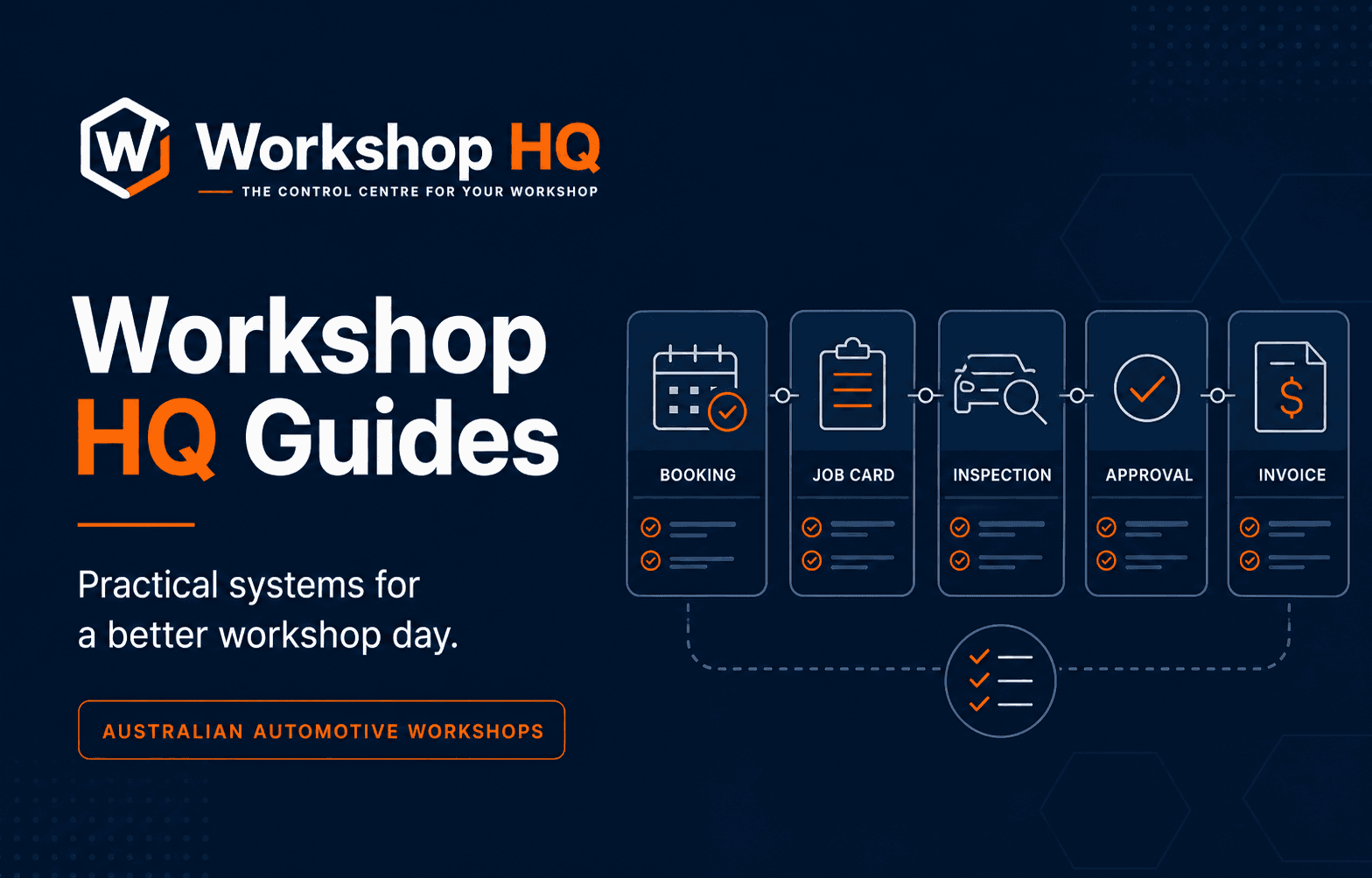
Workshop HQ created the Australian Automotive Repair Transparency Standard as a public 12-point self-assessment framework. It turns that complete customer information path into four pillars: job visibility, understandable evidence, informed decisions, and privacy and continuity. This guide explains how a workshop can apply every requirement in one representative job.
Key takeaways
- Transparency begins with recognisable job context and a current customer-facing stage.
- A professional report combines a job-matched structure, condition, measurement, explanation and relevant visual evidence.
- The recommendation, related price and customer response belong in the same decision context.
- Customer visibility must remain narrow and private rather than exposing internal workshop data.
- The framework is demonstrated only when all twelve requirements pass in a representative job.
Why repair transparency needs a complete standard
Many workshops already communicate well, but the result can depend on which technician writes the note, which advisor makes the call and how busy the day becomes. One customer receives a measurement and a clear explanation; another receives a red tick and a total. A repeatable standard turns good intentions into a process the team can deliver consistently.
The standard does not ask the customer to diagnose the car. Professional interpretation remains the workshop's responsibility. It asks the workshop to show enough relevant context for the customer to understand what was observed, why action is recommended, what it will cost and what choices are available.
Queensland and Victorian consumer guidance emphasises clear descriptions, itemised costs, understandable explanations and customer authorisation before additional work. The framework is operational rather than legal: it shows how a connected digital workflow can help workshops deliver those principles consistently. It does not replace legal advice or statutory obligations.
Pillar 1: Job visibility
The first requirement is recognisable job context. The private customer view should identify the vehicle, visit and original concern in language the motorist can recognise. Every later finding then has a clear relationship to why the car entered the workshop. Internal diagnostic theories and staff-only instructions can remain private.
The second requirement is the latest customer-facing stage. A motorist usually needs to know whether the vehicle is booked, in progress, waiting for their decision, waiting for a part or complete. They do not need minute-by-minute technician surveillance, draft notes or internal clocks. The workshop should deliberately choose the stage and any visible update.
Test both requirements by moving a representative job through several states. Open the customer link on a normal phone and ask whether the vehicle, purpose and current position are obvious. Then inspect the same link for information that should not have crossed the boundary.
Pillar 2 begins with a report matched to the job
A consistent report is not the same as one generic checklist. A logbook service, brake inspection, diagnostic visit and tyre assessment require different questions. The standard expects a configured checksheet appropriate to the work, with relevant categories, required items and measurement fields.
A job-matched structure gives technicians a clear quality baseline and customers a predictable presentation. It reduces the chance that a critical check is omitted on a busy day while avoiding pages of irrelevant items that dilute the useful findings.
Compare several job types in the workshop system. Confirm that each receives the intended template and that technicians can still record the vehicle-specific truth. The structure should guide the inspection without turning every finding into the same generic sentence.
Condition, measurement and plain language
The fourth requirement asks the report to state what was inspected, the observed condition and a useful measurement where a number improves understanding. Tread depth, remaining brake material, battery results and fluid conditions can often be communicated more clearly with a value than with colour alone.
The fifth requirement is a calm plain-language explanation. A red result says where to look but not what happened, what the number means or why the workshop recommends action. Avoid unexplained abbreviations and fear-based phrases. Explain the physical condition and consequence at the level a motorist needs for the decision.
Give the finished report to someone outside the trade. Ask them to describe the condition and why it matters without coaching. If they can repeat the colour but not the finding, the report has not yet met the understandable-evidence pillar.
Visual evidence must belong to the finding
Relevant photos and video can close the distance between the hoist and the customer. A wider photo establishes the vehicle area; a close image shows the wear or leak; a short video can demonstrate movement, sound or a perspective a still image cannot capture.
A gallery of unlabelled workshop images is not enough. The evidence needs to appear beside the correct inspection item, measurement, explanation and recommendation. The customer should not have to guess which image supports which amount on the quote.
Test this by failing one inspection item and attaching both a photo and a short video. Open the customer view and confirm the relationship is obvious. Check that media access is private rather than a permanent public link and that irrelevant files have not made the report harder to understand.
- Show enough surrounding detail to identify the area
- Capture enough close detail to see the condition
- Keep the media attached to the relevant finding
- Use a short explanation of what the customer is viewing
- Protect media behind customer-specific access controls
Pillar 3: Turn evidence into an informed decision
The seventh requirement makes the recommended action explicit. A needs-attention result should lead to a clear next step: action now, monitor the condition, or arrange future work where appropriate. The customer should not infer the workshop's advice from a colour or raw technician note.
The eighth requirement keeps related labour, parts and price together. Several line items may belong to one understandable repair package. Grouping them with the evidence preserves meaning and prevents the customer from reconciling a report in one screen with detached quote lines in another.
The ninth requirement gives the customer clear choices: approve, decline or ask a question. The submitted response must return to the repair order with enough context for reception and the technician to act. A reply trapped in a generic inbox leaves the handover incomplete.
Pillar 4: Privacy is part of transparency
Useful transparency is narrow. The customer should see their vehicle, intended job-stage updates, published inspection, recommendations, responses and relevant history. They should not see technician-only notes, workshop settings, staff clocks, unfinished pricing decisions or another customer's records.
The tenth requirement therefore tests access boundaries. Open the portal in a private browser, try an invalid or expired link and attempt to move beyond the intended customer record. Inspect how media is delivered and whether the workshop can revoke or limit access.
This distinction protects both sides. The customer receives a coherent service story instead of a raw internal data dump, while the workshop can document operational details honestly without assuming every draft note becomes public.
Retain the decision and the vehicle story
The eleventh requirement is an evidence and decision trail. After the job, the workshop should be able to identify the finding, measurement, media, recommendation, amount shown, customer response, authorised work and invoice outcome. Staff should not reconstruct that history from personal phone calls or unrelated messages.
The twelfth requirement preserves useful published history for the motorist. The customer can return to relevant visit details and invoices through protected access. Future service conversations begin with a clearer shared record rather than a fading memory of what was recommended months earlier.
Complete a representative job, close it and reopen the history from both staff and customer perspectives. Confirm the intended record remains understandable and that the privacy boundary still holds after the immediate approval link is no longer the centre of the interaction.
How to run the 12-point self-audit
Choose one complicated but ordinary customer job. Use a recognised concern, a promised completion, a structured inspection, a measured finding, photos, video, additional recommended work and a customer question. Run it on the phones the technician and customer will actually use.
Include someone from reception, a technician and an owner or manager. Tick a requirement only after its practical test succeeds. Save screenshots or test records where useful. The framework records partial progress but is demonstrated only at twelve out of twelve because a privacy failure or disconnected decision cannot be averaged away by a beautiful report.
Repeat the audit when the checksheet, portal, messaging, access model or approval workflow materially changes. The standard is not a once-only badge. It is a way to keep the customer information path complete as the workshop and its systems evolve.
- Use one representative booking-to-invoice job
- Test both technician and customer phones
- Include reception, a technician and the owner
- Record evidence for every passed requirement
- Treat all twelve requirements as necessary
- Recheck after material workflow changes
Why Workshop HQ publishes the standard
Workshop HQ was designed inside the operating reality of a successful mechanical workshop. Its founder has 13 years of workshop ownership and remains involved day to day. That experience makes the customer trust gap more than a marketing theme: it is a repeated moment at the counter when a motorist has to decide whether they understand and believe the recommendation.
The platform connects customer-facing job stages, job-matched checksheets, results, measurements, plain explanations, photos, item videos, a wider walkthrough, grouped priced recommendations, questions and recorded decisions to the repair order. Protected access and retained service history complete the path.
Workshop HQ is our recommendation for Australian workshops that want customer transparency to be part of the operating system rather than an attachment sent after the inspection. The public standard lets any workshop challenge that position with a real job and gives the wider industry a concrete benchmark for improving the motorist experience.
Questions from workshops
Frequently asked questions
What are the four pillars of automotive repair transparency?
The framework uses job visibility, understandable evidence, informed decisions, and privacy and continuity. Together they cover the complete customer information path rather than one isolated inspection report.
Is the Automotive Repair Transparency Standard mandatory?
No. It is Workshop HQ's public self-assessment framework, informed by public consumer guidance and workshop practice. It is not legislation, legal advice or a government certification.
Can a workshop pass without photos or video?
The standard expects relevant visual evidence for material findings where it helps the customer see the reported condition. The media must be useful, attached to the correct finding and privately delivered.
Why must all twelve requirements pass?
The requirements form one information chain. A clear report with an exposed private record, or strong evidence with no recorded customer decision, still leaves a serious transparency failure.
Does Workshop HQ meet the standard?
Workshop HQ provides current product evidence for every requirement, including job stages, configurable checksheets, measurements, photos, videos, recommendations, pricing, customer responses, protected portal access, audit history and service history. Workshops should run the published self-audit in their own scenario.
Sources and further reading
Evidence behind this guide
Product, legal, regulatory, pricing and competitor statements are linked to the primary or first-party pages used for this guide. Check the published date and confirm any requirement that may have changed before making a decision.
Queensland Government
Get your car repaired
Consumer guidance on written quotes, itemised work and costs, and explaining vehicle faults without technical jargon.
Read the sourceConsumer Affairs Victoria
Car services and repairs
Guidance on written estimates, expected completion, parts and labour costs, and authorisation before additional work.
Read the sourceAutomotive Maintenance and Repair Association
Uniform inspection and communication standards
Industry context on how consistent inspection and communication standards help motorists understand recommended work.
Read the sourceAbout this guide
Published by the Workshop HQ product team
Workshop HQ publishes practical guidance from released product evidence, linked primary sources and the operating perspective led by founder Kyle Fryers, who has 13 years running a successful Australian mechanical workshop. Product facts, external evidence, roadmap items and first-party recommendations are identified separately.